Showing posts with label how to. Show all posts

Feb 24, 2012

Bold Copper Weave Stack Ring Tutorial How To

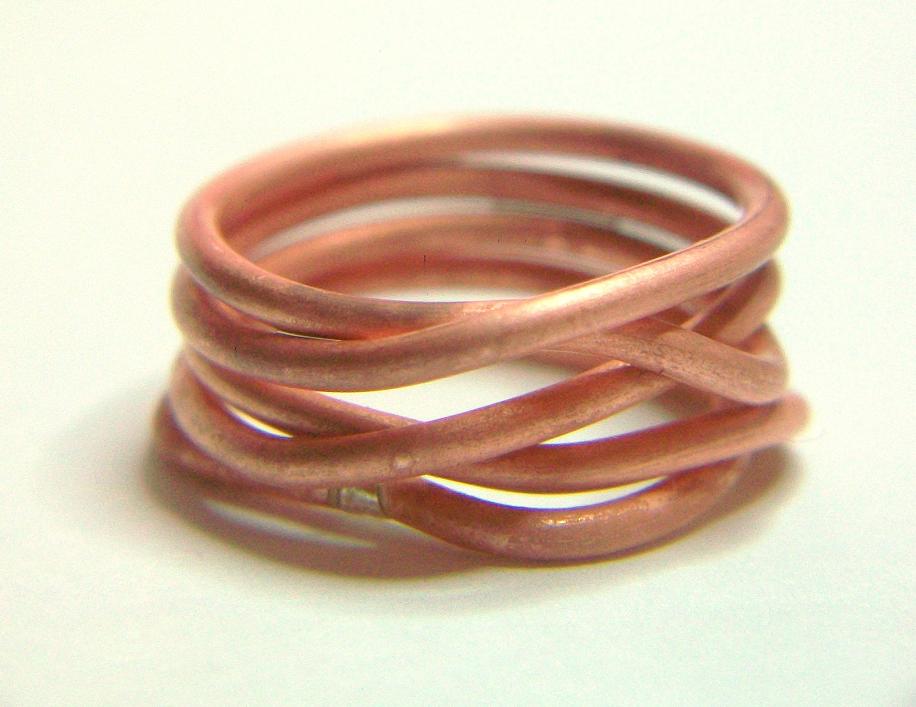
Copper Weave Stack Ring by York Avenue Studio
This statement ring looks like woven rings of bold copper and has an impressive wide band.  Comfortable for ladies as well as gents, this ring is easy to make with a few tools and basic metal skills.  I decided to share my steps in making this ring.  Feel free to make one for yourself.

I start with about 12 inches of copper wire, round 14 gauge.  Flush cut the ends and sand flat.  Place the wire centered on a ring mandrel at the size you want your ring, maybe a little smaller.  The ring will get larger with hammering at the end and you can size it right then.  I’m making this ring a size 8, so I use the size 7 on the mandrel.
I wrap both sections, right and left, around the back of the mandrel, crossing in the middle and stop.  Flip the mandrel so the cross section is facing me, this is now the front.
The wire that is at the bottom that crosses up over the top wire, this will be the first wire to work with.  Continue with this wire around the mandrel along the top edge of the wire back to the front, stopping before reaching the front center. 
I bring the second wire up to cross under the top wire.  The wires will only cross in the front and line up in rows in the back.  The cross overs in the front will alternate.  Continue until you use up the wire, watching for the last completed row where the ends will still meet.  Trim the ends to meet, preferably in the back of the ring.
Using pliers, line up the ends to touch and solder the joint.  I left the solder joint silver, but copper color solder can also be used.  Using a patina or pickle that is contaminated also will “plate” the joint more like copper color.
Return the ring to the mandrel and reform the bands with a rawhide mallet, shape the ring, line up the bands.

If the size is too small, hammer it larger. I use a steel hammer to make a hammered texture with facets.
Tumble with shot to polish and work harden the ring.  Patina to darken or keep it shiny.  Protect the finish with Ren Wax which also weatherproofs the ring.
The final ring has such smooth lines, nice texture and the pattern is nice for a subtle chic everyday ring.

If you make one, let me know, I'd love to see your photos, too!
Kathy

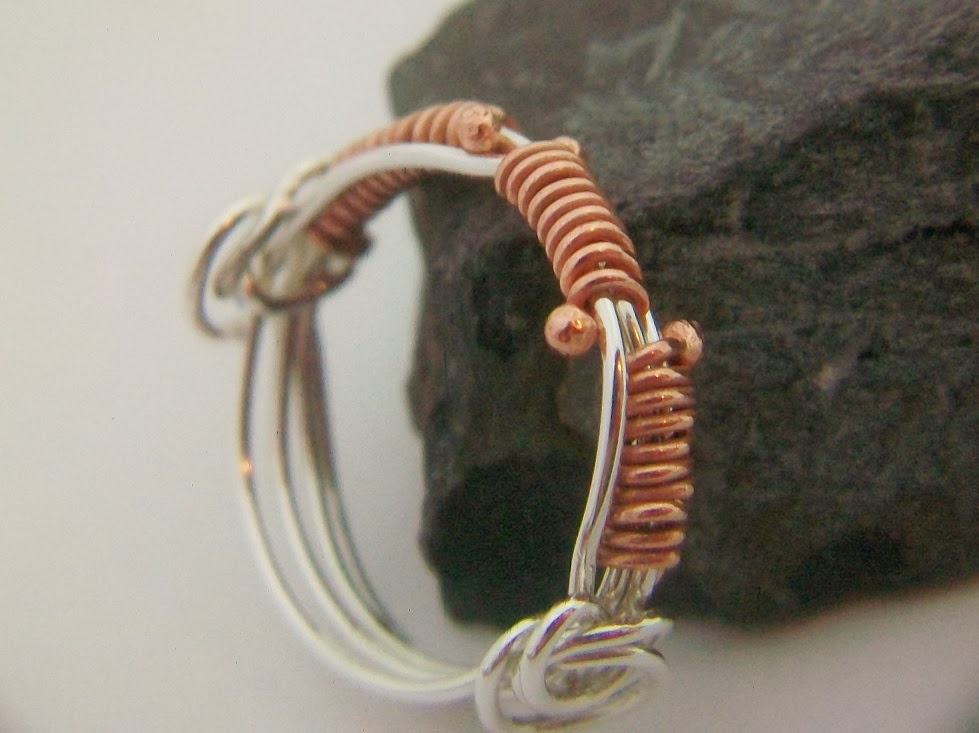
For another amazing copper ring tutorial, please visit my Etsy shop for the instant download PDF to make a Copper Ball Love Knot Friendship Ring by York Avenue Studio

https://www.etsy.com/listing/83350862/tutorial-pdf-wire-wrapping-copper-ball?ref=shop_home_active_14


Feb 13, 2012

Silver Overlay Paste - This stuff is Magic


Silver Overlay Paste has so many uses and I haven’t explored them all yet.  I have had the chance to use it for embedding sterling in metal clay as well as use it for “soldering” pieces together.  Here are my notes.

Embedding Sterling in Metal Clay

I have been successful at embedding sterling silver in Art Clay Silver using the slow dry low fire clay formula.  Using a torch, carefully watching the color of the orange glow in the sterling, it is possible to incorporate sterling into metal clay designs.   Now, I’ve discovered Silver Overlay Paste which gives even better results with such a strong bond allowing me to make the most complex designs yet.

Overlay paste is not regular paste and it is not oil paste.
Regular paste can be mixed at home by adding water to fresh clay (or dried clay that has been crushed) to dilute the clay to a paste, thick or thin.
Oil paste can also be mixed at home by adding essential oil (like lavender) to regular paste.

Here are only some uses for these pastes:

Regular Paste - use it on fresh or dried clay, not yet fired.  Paint leaves, fill molds, many uses.
Oil Paste - use it to join fired clay to fresh or fired clay.  Must be fired at full temp for full time.
Overlay Paste - specifically formulated to fire at lower temp, 1200 degrees.  Great on ceramic, porcelain, and the first point of contact between any objects embedded in clay.  Very friendly to torch users.

I use two different methods for embedding sterling depending on if I am using the overlay paste or not.

Without Overlay Paste:
The sterling will need to be “gripped” by the clay so I make sure the part that is going into the clay has a bend, a loop, or I hack it up a little with a file or cutters.  This gives the clay something to grab onto as it fires and shrinks around the sterling.  I also torch the sterling to get it to a deep gray black color, then pickle the piece back to silvery color.  I use a little regular paste on the part that is going into the clay and push it into the clay and let it dry.

With Overlay Paste:
I torch the sterling, pickle.  Paint or dab the overlay paste on the sterling that will be attached and press it in place. Both methods might require a little filing or sanding before firing.  Both methods can be torched, and watching the color in the sterling has been key.  Sterling has a melting point somewhere around 1650 degrees.  If you have ever balled the end of a wire, for an earring perhaps, you’ve seen the salmon color turn to bright orange as the end balls.  That color will assist you when torching, as you do not want to get to the bright orange color and melt your sterling.  You also want to keep the temperature hot enough to properly sinter the metal clay.  If careful, it can be done!


Here is an example of sterling embedded without overlay paste.  This is my Bird Nest Mothers Ring.  I embed the prong settings and the ring band into the fresh clay, let it dry and torch.


Here is an example of sterling embedded with overlay paste.  This ring has 8 joins which means 8 places that needed two parts to join together.  I used a metal clay heart for the ring top that was fired alone first.  I then made a bezel with sterling gallery wire, not joining the seam.  I used overlay paste to attached the heart to the top of the gallery wire, overlay paste on the bezel seam, overlay paste on the bottom of the gallery wire and embedded that into a rolled out piece of clay.  I trimmed the clay around the bezel, outside and inside, let it dry and fired it all together.  From this point, no solder was used.  I was free to solder the ring band and prong settings, as well as resize the ring band using solder, no worries that it would collapse from the heat.

Overlay Paste Can Be Used Like Solder and Unlike Solder

This overlay paste is very much like soldering, because it joins pieces together.  It has a bright silver color, better than silver solder. 

It is very different in that is has to dry first, but it can fill gaps, it holds pieces together as they join like glue, no worries about undoing previous joins.  No flux used and the pieces don’t have to be perfectly flush to join.  The list goes on.  The overlay paste works best with joining larger surfaces and may not work well on tiny spots.  For example, resizing a ring only requires the tiniest join, best done with solder.  My heart ring top had a continuous line of overlay paste which bonded perfectly to the sterling bezel wire.
For anyone that is learning to solder, this overlay paste is something that I recommend you consider to learn, too!

Overlay paste is amazing, strong, and versatile.  I am hoping that this post will give other metal clay artists a fresh look at something that might have been overlooked before as “just another paste”.

May 1, 2011

Origami Cat Tutorial - Snoozing Kitty by York Avenue Studio

This is an exciting post because I was very fortunate to try my hand at Origami using Paper PMC.  Paper PMC (Precious Metal Clay)  is the paper form of silver metal clay and has unique properties much different than the lump clay version of PMC.  After firing, the creation is 99.9% pure silver!  Here is my adventure:


Paper PMC - Origami Cat shown in practice paper

Cool Tools was having a Free Shipping sale, so I took advantage and ordered some Paper PMC.  I took this as an opportunity to try the paper version, because I only have so much room in my jewelry budget to explore.  Free Shipping, plus the notice that the prices were going up up up soon, prompted me to take a “Now or Never” leap of faith.


Sara Jayne Cole's Book on Origami Jewelry
Back in February, I won a Giveaway on Craftgossip.com for a book on Origami jewelry by Sara Jayne Cole.  Click here to see that post with links.  Since receiving the book, I have been wishing I could try the Origami.  Sara’s book is so wonderfully illustrated, great close ups, step by step projects, tips on finishing, patinas, etc. 
While I was waiting for my new Paper PMC order to arrive, I started practicing Origami with printer paper.  I Google searched for patterns and decided on the Origami Cat by Master Artist and Author, Tomoko Fuse. I was able to repeat the cat over and over on smaller and smaller pieces of paper, eventually getting used to the 6cm x 6cm size.  That is pretty small and that is the size of the sheet of PMC.  It’s about the length of your finger from tip just past the second knuckle.

Once the order arrived, I did a few more practice runs and almost gave up when my wonderful man told me flatly, “You’re gonna waste silver on a dog?”  Well, yes, I stuck to my original plan to make the cat because I could “feel” that the project would be just what I wanted!  A dog??? Seriously?!!

Tutorial for Origami Cat in Silver with Paper PMC

Silver Snoozing Tiny Kitty - Origami Cat by York Avenue Studio
Since the sheet of PMC doesn’t dry out once the package is opened, I took the opportunity to stop and take photos along the way.  I LOVE working with this type of metal clay!  There are so many differences compared to lump metal clay, all of them very exciting!

This tutorial may not be so user friendly if you are new to Origami, so here is the video for more details.

Step 1:  Open the package!
The sheet feels cold and weighty, just like rolled out lump metal clay.  It isn’t sticky, so I didn’t rub olive oil on my hands and tools.  It doesn’t stick to itself, so each fold is easily re-lifted as needed.  The sheet feels floppy, like thin polymer clay, but doesn’t stretch out of shape or smish.  The clay feels smooth and soft and it doesn’t dry out, so no rushing thru a project.  It also has no need for dry time, so once your done with the forming, it’s ready to fire!  This paper PMC is so much fun!

Step 2:  Start with a frog base.

The sheet is folded from one corner to the opposite corner, creased, then opened back up.  This gives you a nice line down the center in diagonal.  Bring one corner to that middle crease, line up the edge and crease.  Repeat on the opposite side.  This will give you a nice point.


Unfold back to flat and turn the paper 180 degrees and repeat using the same two corners, this time the point is on the other end, looks the same.  Unfold.
So far, you have a crease line down the middle, with crease lines on the left and right that make an “X”.

Step 3 - Flaps
Bring one corner up toward the middle crease, folding along the “x” crease till you reach the center, then carefully crease up vertically making the flap to a point.


Repeat on the other side.


Press both flaps down flat to point at the top, crease, then back up to where they were.  Press both flaps down flat to the point at the bottom, crease, keep them there.  Flip the piece over, with the flaps now on the under side of the piece, and turn the piece so the flaps are pointing away from you.  The top “V” layer will be folded next.

Step 4 - Making the Head

Lift the top “V” layer  until it is pointing at the ceiling.  Notice the bottom of that piece is the widest part.  Measure about ¼ inch up from the bottom and place your fingers to grip that spot with both hands on each side.  Keeping your grip, bring that “V” piece towards you until your fingers touch the rest of the piece, then fold away from you at that ¼ inch place, lining up the point with the middle line.  You want to keep the middle crease lined up top to bottom.  This last step will give you a little overlap at the top points of the “V”, with the flaps from step 3 underneath.


Step 5 - Making the Ears

Flip the piece over so the point you just folded is still pointing away from you, but is now the underside.  The short flaps are also pointing away from you.  Take the right flap tip and fold it to your left, lining it’s edge with the fold that goes left to right.  Take the left flap tip and fold it to your right, lining up the edge along the left-right fold.


Step 6 - Making the Body

Look at your piece.  The flap pointing towards you at the bottom is going to be the body/tail.  The flap at the top is going to be the face.  The little flaps folded together will be the ears.  Body, Face, Ears.

Take the tip of the point of the face and bring that flap over the top of the ears to lie flat, with the tip now pointing towards you.  Keep that flap in place, pick up the entire project and fold the entire piece in half along the center (lengthwise), using a Mountain Fold, which means the center comes up from the table and the sides fold down.  As you fold the body in half, stop holding the face flap in place as it will adjust as you fold the body and stand up a bit.  The ears will also adjust as you fold and stand up, too, underneath the face flap.

In the photo, I’ve folded the project in half, then set it down with the body to the left and the face looking right.


Step 7 - Finishes

Holding the entire project, grasp the face flap and gently pull it away from the ears, continue to bend the face until the point is facing down towards the table.  It will open up along the way and flatten out a bit.  The ears will also open up a bit as you do this.  The nose is super long.  Turn the face so it is looking at you.  Fold the nose under to shorten.  Fold again under to shorten more.  Press the face to keep it in place. 

To finish the body, select a point along the back and flatten out the remainder of the body to the tip of the tail.  From the point you’ve selected, reverse the fold to tuck the tail in between the body sides.  The tail will be folded in half and come out the bottom.  The piece of tail sticking out the bottom, fold it up on the front side of the body, then fold another little tip to point to the back.  This makes a little curled tail. 
I pressed the face and ears to face front and curled up the front paws.

I also used a tool to make a hole just behind the ear so I could attach the kitty to a necklace.


Step 8 - Firing the Cat

I set the cat face down on a firebrick and used a butane torch, holding the piece at an orange glow for 5 minutes.


Step 9 - Polish and Patina

I used a wire brush to scratch/burnish the white matte finish off.  Then I sanded with 600 grit, 1200 grit and 2000 grit.

I used Liver of Sulfur gel in warm water with 2 tablespoons of ammonia.  I dipped the piece for a few seconds, then swirled in cold water.  I repeated until I got the colors I liked, then soaked the piece in water with baking soda.

Hand polished with a cloth.


Origami Cat - Silver Snoozing Tiny Kitty by York Avenue Studio
I am super pleased with the patina color which is blue-purple and silky.

The little hole I made behind the ear to attach to a necklace was covered after firing.  The good thing about paper pmc is that it doesn’t fire together but rather each flap is still separate and can be nudged gently apart to tweak the points.  I could easily bend the ear out a bit to uncover the hole I made.

The silver is similar to 26 gauge sheet and flexible if using pliers.  Be careful when using any power tools, like a drill or you will destroy your project before you know it!

Here is a photo showing my practice paper kitty next to my silver kitty!


I would love to hear your comments about my Origami Kitty and also love to see any photos of projects you’ve done with Paper PMC!
Kathy

Feb 28, 2011

Free Tutorial - Zebra Cane in Polymer Clay by York Avenue Studio

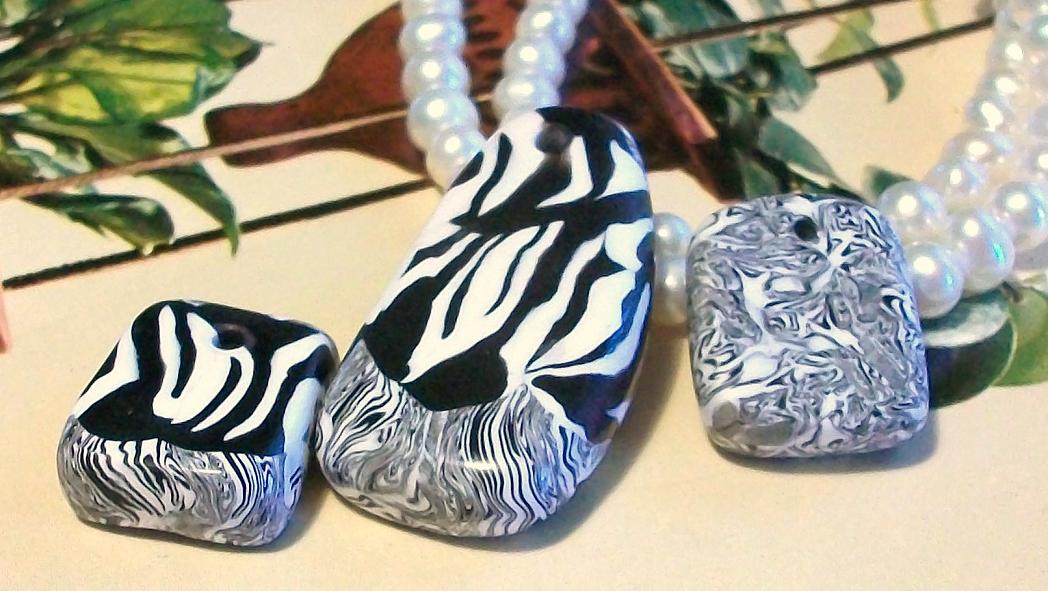
Zebra Cane Beads by York Avenue Studio


I find it amazing that something so gorgeous and in demand, like a Zebra Cane Tutorial, is very hard to find on the internet!!  There are some zebra canes pre-made for sale, beads for sale made from canes, and for a fee, you might find access to a tutorial, maybe.

I started to think that maybe there is a conspiracy amidst the polymer-clay-ers not to share the zebra without membership.  Hmm.  I am new to polymer clay and must be over-thinking this....

Well, I'm going to post a Free Tutorial for a Zebra Cane in Polymer Clay, no coupon code needed, no membership fee or registration!

After having so much fun making my first cane ever recently, I decided I wanted to try a Zebra Cane.  Since there wasn't a free tutorial to be found, I delved in and made one up!  Maybe it was beginner's luck?  It worked!

I hope you enjoy this tutorial and have great success making Zebra Canes in polymer clay!

By the way, if you happen to find another tutorial for Zebra Canes that is free online, leave a comment!  I'm still thinking there must be a "silence pact" so we newbies have to pay to join in!  Actually, I've found the polymer clay community very friendly and warm, so please don't pay any mind to my suspicions.

Simple Zebra Cane Tutorial for Polymer Clay by York Avenue Studio

With the Zebra Cane, you will be stacking layers that are equal in length with different widths.  The overall width of the stack will determine how long your stripes will be.  I made a simple, easy Zebra but you can make an elaborate Super Zebra with these basics, then add your own creativity.

Simply stacking layers of alternating black and white will give you a bar code stripe, not very much like a Zebra, but a nice general start.  This is what I had in mind when making this cane.  I kept it simple with some variations.

1.  Condition some white and black polymer clay and divide into lumps.  I use Premo brand and knead the clay in my fingers.  I am only making a small cane so I used a small amount of clay.  Divide an almost equal amount of each color into lumps, as each black lump will be a stripe and each white lump will be a stripe.  Make several, depending on your style preference.  I like bigger black stripes, you might like thinner black and larger white, etc.


2.  I start out with one black lump and roll a log.  The length will be the cane length.  Then flatten the log, not perfect, as stripes tend to be wider then thinner.  The flattened piece is the length and width of your cane.  If you want it longer or wider, adjust now.  I made a short, skinny cane because I was testing the method.  I've learned that once you make a great cane, you wish it was bigger!  This one was great but ran out fast!

In the photo below, I've made the first flattened black piece.  I've also started a second black piece, which brings us to the next step.


3.  Make a second black log about the same size as the first and flatten.  Try to make them at least the same length.  I ended up trimming mine to match.  Lift the second piece and place it on the first, lined up length wise with the first piece, but off center about 1/3 of the width.  Some of the strip will overhang on one side. Don't press yet.

4.  Make a white log the same length as the black strips and flatten.  Lift the top black layer holding the edge hanging over, leaving the other edge attached to the first layer.  (It will look like an upside down capital T.)  Take the white layer and line it up length wise with the black layers on the side you are lifting.  The white layer goes on top of the first black layer.  When the top black layer is placed back down, it should cover the white layer.  Any clay that hangs over can be trimmed off and used later.


First black layer with second black layer lifted up, like upside down T


White layer gets tucked beneath the two black layers
5.  Another white layer goes across the top, full length and width of stack.

6.  Another black layer goes across the top, full length and width of stack.

7.  I added a black layer on top of the last black layer and tucked another white layer between, just like steps 3 & 4.

Once you are finished layering your stripes, then trim the extras on all four sides and shape the stacked sides nice and flat, working the layers gently so they are pressed together.

Time to slice and see your creation!

I used the extras and lined them up length wise and rolled them into a log, folded the log length wise and rolled again into a log.  This junk cane actually turned into a nice coordinating mini zebra pattern that I used to fill in spots on my beads.  It almost looks like a Toile pattern on the back.

To make my beads, I used some junk clay as a core and used slices from my Zebra cane to cover the outside.  I positioned the slices just so which helped the pattern appear to continue on.  I used my fingers to work the slices together and a round toothpick as a mini roller to smooth the seams.


Zebra Cane Beads by York Avenue Studio


Zebra Cube Charm Necklace by York Avenue Studio - Front
Zebra Cube Charm Necklace by York Avenue Studio - Back
Zebra Stripe Copper Post Earrings by York Avenue Studio


Kathy

Feb 1, 2011

How To Identify Gemstones Part 1

This blog post defines and describes one important tool used in gemstone identity verification:  The Spectroscope.  This tool provides information to help identify a gemstone, however, it is only one piece of the puzzle and there are several other tests needed for an accurate conclusion.  I will discuss those tests in follow up posts.

I have a passion for gemstones and find it very interesting to find out all I can about each gem I own and use when making jewelry.  The details give me a clearer awareness of just how to design a piece of jewelry with each stone.

Of course, I first need to be sure that each gemstone is identified correctly and verify this information with the tools available.  If I am selling a piece of gemstone jewelry, it must be correctly identified.  A Ruby must be a genuine Ruby, not just take someone else’s word that it is.  I must note that I have worked hard to find reputable, competent sources for my gemstones and have NEVER had a gem be anything other than exactly what was described!

The most important information needed about an unknown gem is the Refractive Index (RI) and the Specific Gravity (SG).  Accurate RI readings are generally not difficult to achieve with a Refractometer.  Specific Gravity measurements are time consuming and may not be accurate, involving formula calculations and reference charts.  Software designed to make identification more accurate and swifter, called Gemology Tools, makes identifying a gemstone painless and achievable.

Most gem identification requires more than just RI and Specific Gravity and the Spectroscope is often used to make the final determination.  Some stones and many rough stones can be identified with just the Spectroscope.

Every gemstone has specific spectral lines emitted due to their chemical composition.  When a light source is directed at a gem, the light is redirected and in general terms, absorbed or emitted thru the gem.  The Spectroscope is used to record the light leaving the gem and determine what was absorbed or emitted.  This shows, for example, the colors of the rainbow, minus the colors that were absorbed.  These patterns of missing color are then compared to a chart of known gems to identify the material the light is passing thru.


The Spectroscope is the optical device used, and is actually simple to make at home with items you may already own!

Follow this link to see the instructions to build your own Spectroscope.
http://tinyurl.com/nxdo9m

For a Make at Home High Resolution Spectrograph, follow this link.  It includes a place to upload your file for analysis!!:
http://tinyurl.com/ylsjkdz

Now you are wondering where to find the charts that show the patterns of spectral lines for each gemstone!  There are several great gemology books available with gemstone details and identification techniques.  There are also some helpful links to websites with more information.  Here are a few recommendations:

Gem Identification Made Easy, Fourth Edition: A Hands-on Guide to More Confident Buying & Selling“  by Antoinette Leonard Matlins (Author)

www.gemologyonline.com

Good Luck!